FAQ: Fox Hunting in England and Wales
If you are new to all this, or just want to remind yourself, here is a handy list of Frequently Asked Questions.
Fox Hunting
Q: Is fox hunting illegal?
A: Fox hunting is illegal in England and Wales. It remains legal in Northern Ireland. The Hunting Act 2004 outlawed pursuing a wild mammal with hounds for pleasure.
Q: How many fox hunts are there?
A: There are around 200 registered hunts, plus a number of unregistered hunts. Not all hunts are fox hunts. Some are hare hunts (harriers, often, but not always), some are stag hunts, and some mink hunts.
Q: Where do they hunt?
A: The UK is divided into hunt countries—defined areas where hunts can operate. They need permission from landowners to hunt on their land. Allowing illegal hunting to take place on your land is a crime. Landowners play a significant role in enabling hunting. Many large landowners (for example, the National Trust and Forestry England) have banned hunting from their land. Some hunts share country.
Q: How often do hunts go out?
A: In season (autumn to spring), hunts go out two to four times a week, depending on the size of the hunt and the number of hounds.
Q: Who are the people on a hunt?
A: A hunt consists of several roles, plus other riders:
- The Masters — the people in overall control. There is usually more than one master.
- The Huntsman — controls the hounds and is in charge of breeding. There may be more than one huntsman out on a hunt. This person may also be a Master.
- Kennel staff — care for the hounds.
- Terrier men/women — often use quad bikes. They are the “thugs” of the hunt. They carry shovels and bring terriers to dig out foxes that “go to ground” (hide in a hole).
- The Whipper-in — a trainee huntsman responsible for managing hounds, maintaining kennels, breeding, and preparing fallen stock for rendering.
- The Field — riders who have paid to join the hunt.
- Foot Followers — people on foot or in vehicles. These range from those who are masters/other hunt officials and hunt staff current and retired, landowners, regulars who have been coming out for decades, random people who just turn up every so often. In cars, on quads, bikes and on foot.
The Law, Breaking the Law, and What’s Happening Now
Q: Do hunts break the law?
A: Yes. Many hunts continue to pursue wild mammals and kill them, despite the Hunting Act 2004, which outlawed the pursuit of wild mammals for pleasure. Evidence can be seen here, on the Hunt Saboteurs Association website.
Q: How do hunts get away with it?
A: Since 2005, hunts have claimed to practise “trail hunting”—claiming the hounds are following a scent trail laid by a person.
Q: Why do we not see them in court?
A: Although there have been more court appearances and convictions recently, catching a hunt in the act is extremely difficult and is usually left to hunt saboteurs. Many hunts are not sabbed. Lack of police resources is also a problem.
Q: What’s happening now?
A: The Labour government has promised to outlaw trail hunting and has acknowledged that it is used as a cover for fox hunting. In December 2025, they published their Animal Welfare Strategy and trail hunting was included. We are waiting for them to publish a consultation, where the public will be able to contribute. However, the consultation has been delayed (yet again).
Q: Why didn’t the Hunting Act work?
A: The Hunting Act did not ban hunting outright, and hunts have exploited every loophole. The biggest loophole is the definition of hunting, which does not cover enough hunt activities and does not make “accidental” kills illegal. Exemptions in the Act also provide major loopholes. More details about failed hunt investigations and prosecutions can be found in our report “Broken Law”.
The Fox Hunt Itself, and the Hounds
Q: What happens on a hunt?
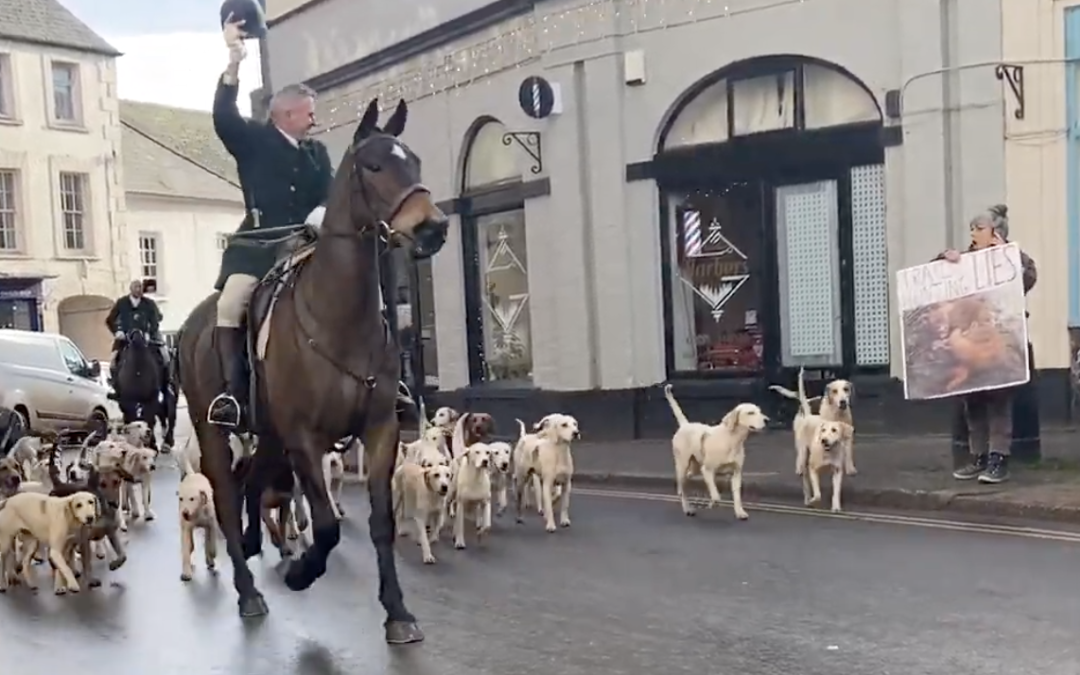
A: Hunt staff arrive at a “meet” with the hounds. Meets are held on farms or other locations (sometimes pubs). Paying riders—the field—arrive on horseback. Terrier men on quad bikes also attend. After socialising, the hunt sets off. Hounds are taken to areas where foxes are likely to be resting and are sent in to find a scent. When a fox is found and breaks cover, the hounds pursue it, followed by the horses, riders, and people in 4x4s who watch from roadsides. The hounds either catch and kill the fox or lose it. If a fox is killed, terrier men remove the body and the hunt moves on to find another. Hunts often begin around 11 a.m. and may continue until dark. Hunts often chase more than one fox during the day’s hunting.
Q: How many foxhounds do hunts have?
A: It varies. Some have around 80 hounds; others have fewer. Hunts refer to hounds in “couples,” meaning pairs—so “thirty couple” means sixty hounds. A hound’s working life is around 6–8 years, after which they are usually shot. Dead hounds and other remains are sometimes rendered—boiled down for products like soap.
Q: How do hounds track foxes?
A: Hounds primarily hunt by scent, not sight.
Q: Are any other animals affected?
A: “Earth stopping”—blocking escape routes such as badger setts—is common. Hounds can “riot” on any wild mammal and sometimes kill deer. Domestic animals are also at risk; hounds have killed and injured cats, dogs, and alpacas.
Q: Are hounds always under control?
A: They should be, but they are often seen running about in small groups or alone, with no huntsman in sight. Some hounds, known as “skirters,” stray from the pack and hunt independently.
Q: What roles do terriers and terrier men play?
A: Terrier men use trained terriers and radio devices to locate animals underground, often engaging in harmful practices such as blocking badger setts.
Q: What illegal activities are associated with hunting?
A: “Bagged foxes” may be brought to hunts and released so the hunt can have a chase. These are foxes trapped and kept for this purpose. Hunts also maintain “artificial earths”—man-made dens encouraging foxes to settle so they can be hunted. Hunts are also responsible for trespass, badger sett blocking, criminal damage, theft and violence.
Hunt Saboteurs and Hunt Monitors
Q: Who are hunt saboteurs?
A: Hunt saboteurs (“sabs”) are members of the public who follow hunts to protect foxes. They use body cameras and drones to capture illegal hunting. They may also use citronella to mask fox scent. Some, but not all, wear masks.
Q: Who are hunt monitors?
A: Hunt monitors also follow hunts, but their role is specifically to film and gather evidence of illegal hunting.
Q: What steps can the public take to help prevent abuses?
A: Report hunt activity to:
- Hunt Sab Tip-Off Line: 07443 148 426
- Police: 999 if you see a hunt actively chasing a fox or other animal; 101 for later reporting
- Crimestoppers (anonymous): 0800 555 111
Cub Hunting
Q: What is cub hunting?
A: Cub hunting trains young hounds by targeting fox cubs to teach them how to chase and kill, preparing them for the main hunting season.
Q: What methods are used?
A: A common technique, “holding up,” involves surrounding cover to force cubs to run. Underperforming hounds may be held back or culled after the season.
Q: How does cub hunting differ from fox hunting?
A: There is no “Meet Card”, meaning that the hunts go out when they decide. It takes place early in the morning or towards evening. Cub hunting is also illegal.
Hunting Traditions
Q: How did hunting traditions evolve over time?
A: Hunting traditions were influenced by historical events such as the Norman invasion, which contributed to the transition from stag hunting to fox hunting.
Q: Who contributed to the breeding of hunting hounds?
A: French monks played a key role in early hound breeding, establishing lines central to European hunting traditions.
Q: How were early hunts organised?
A: Early hunts were private events led by a hunt master, structured around strict hierarchies.
Q: When did organised fox hunting begin?
A: Although hunting is ancient, organised fox hunting as a sport developed in the 18th century. It grew from stag hunting.
Q: What were some historical practices in fox hunting?
A: Historical texts describe cruel practices such as chaining foxes for breeding and using harsh methods to train hounds.
Hunt Governance, Connections, and Finances
Q: Who oversees hunt sports in the UK?
A: The British Hunt Sports Association governs registered hunting packs and sets rules and standards. The Hound Sports Regulatory Authority handles discipline. This replaced the discredited Hunting Office, known for the leaked seminars in 2020.
Q: What industries are hunts connected to?
A: Many hunts are linked to farming and the meat industry. They often run dead stock collections—picking up animals that die in the field. The dead stock is fed raw to hounds.
Q: What related events are associated with hunts?
A: Point-to-point meetings and pony clubs are commonly linked to organised hunts.
Q: What type of organisation is a hunt?
A: Hunts are often commercial businesses.
Q: How do hunts finance themselves?
A: Donations, fundraisers, grants, and property rentals. Point-to-point races are also fundraisers.
